You’re Not Behind: A Practical Guide to Building AI Agents in 2026 (Without Coding)
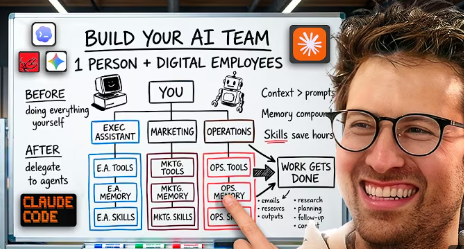
2026 quietly became the year automation stopped being a developer-only club. The shift isn’t about chatbots anymore—it’s about AI agents acting like digital employees that handle real work. A recent breakdown from Futurepedia makes one thing clear: the barrier to entry has collapsed.
Here’s the blueprint.
First: What an AI Agent Actually Is
A chatbot answers. An automation follows rules.
An AI agent thinks in steps and takes action.
Every agent is built from three parts:
1) The Brain
A large language model that can reason through multi-step tasks.
2) Memory
Short-term context + long-term knowledge so it doesn’t start from zero every time.
3) Tools
Connections to the outside world—web search, email, docs, CRMs, databases.
Put those together and you don’t get a script. You get a worker.
The Mental Model That Makes This Click
Agents aren’t replacing jobs.
They’re replacing workflows.
The best way to think about it:
Humans → judgment
Agents → execution
Picture a junior employee who can work instantly, endlessly, and cheaply—but still needs oversight. That’s the sweet spot.
Before Touching Any Software: Find the Right Tasks
Most people start with tools. That’s backwards.
Start by documenting what you do all day.
Once the steps exist on paper, filter them with this rubric:
High frequency → done often
Time-intensive → eats hours
Structured → clear inputs and outputs
Low precision first → 90% accuracy is fine
Research, drafting, summarizing, and lead qualification—perfect starting points.
Accounting, legal, finance—save those for later when guardrails exist.
Two No-Code Paths to Building Agents
There are two dominant approaches right now. Think of them as autopilot vs cockpit.
Path 1: Zapier — The Easy Autopilot
Zapier’s new agent builder works in plain English. Describe what you want and it assembles the workflow.
Example workflow: Sponsorship request triage
Trigger → New Google Sheet row
Agent → Research the company online
Output → Write a report → Create a Google Doc
The key shift: the agent can reason.
If a URL is weak, it decides to search for a better one. That used to require manual logic.
Zapier = fastest path from idea → working agent.
Path 2: n8n — The Advanced Cockpit
If Zapier is autopilot, n8n is a flight deck.
Still no coding required, but you’ll touch:
- JSON
- API keys
- branching logic
You connect nodes visually:
Brain → tools → outputs → loops → conditions.
This is where complex, multi-step workflows live. If you want deep control, this is the playground.
Mistakes That Slow Everyone Down
Building agents is a skill. Expect a learning curve.
Garbage in → garbage out
Bad data = bad decisions.
Graduated autonomy
Start with human review before letting agents run freely.
Guardrails matter
Customer-facing agents must resist manipulation and bad inputs.
Think training wheels before self-driving.
The Real Skill to Learn: Agent Literacy
This isn’t about mastering Zapier or n8n.
It’s about learning how to design workflows for machines.
When a 4-hour task becomes 30 minutes of review and decision-making, you’ve crossed the line from user → operator.
That’s the shift happening right now.








Post Comment