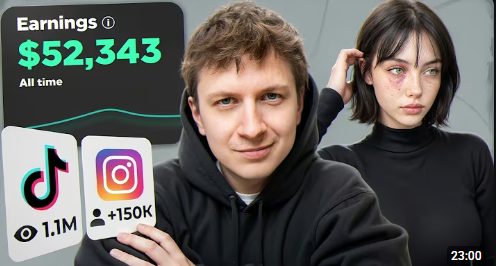
I Built a Fake Influencer in 34 Days and Made $52,000 — Here’s What Happened
Here’s a rewritten version of the blog post:
I Built a Fake Influencer in 34 Days and Made $52,000 — Here’s What Happened
The influencer you’ve been double-tapping on Instagram might not be a person at all.
“Mura” has 300,000 TikTok followers, 200,000 on Instagram, and over 100 million views across her content. She also doesn’t exist. She’s a fully AI-generated persona pulling in over $50,000 a month — and she’s not alone.
Inspired by this, YouTuber AlexK decided to run a 34-day experiment: could he build something similar from scratch, with no existing audience and minimal investment? The answer turned out to be a resounding yes — and the lessons along the way were stranger than he expected.
Why “Worse” Video Actually Performs Better
The instinct most people have is to make AI content look as polished and realistic as possible. AlexK quickly learned that’s the wrong approach.
Crisp, high-resolution AI video tends to trigger the uncanny valley effect — it looks almost real, but something feels off, and viewers clock it immediately. Lower-quality footage that mimics the look of an iPhone 6 recording actually blends in. It feels native to platforms like TikTok and Instagram, where raw and unfiltered content thrives.
He also leaned into what he called the “mask” technique — rather than generating entire scenes with AI, he kept real-world backgrounds (a real kitchen, a real street) and only swapped in the AI-generated face and body. The contrast between a genuine environment and an artificial person, paradoxically, made the whole thing feel more believable.
Building a Face People Trust
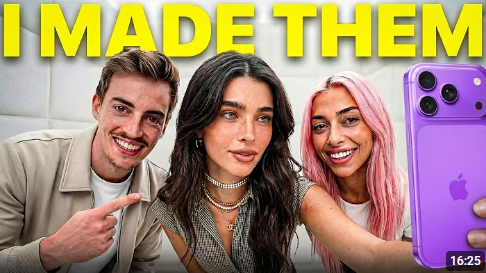
Rather than prompting an AI to generate a face from scratch, AlexK used a tool called Nana Banana to blend photographs of two real women into something new — a face that feels familiar and grounded rather than algorithmically perfect.
He also deliberately added small “imperfections” to his character, Diana Zuka — birthmarks, subtle scars. These details worked. People didn’t just scroll past; they stopped, followed, and engaged. Flaws, it turns out, are what make a face feel human.
The Money: It Goes Further Than You’d Think
Most conversation around AI-generated personas gravitates toward adult content platforms, but AlexK’s experiment showed the business model is actually much broader.
Diana earned close to $1,000 in two weeks through subscriptions and tips on a platform called FunView. But the more interesting revenue streams came from elsewhere. A vaping brand offered her a remote UGC (user-generated content) gig — product videos for $800–$1,200 a month — without ever questioning whether she was real. Other creators in the space are reportedly earning thousands just to feature specific music tracks in short clips.
The total spend to build all of this? Around $250 in AI tools over the course of the month.
The Uncomfortable Part
Not everything about this experiment was a triumphant hustle story.
Diana’s audience skewed heavily toward users in the Middle East, and despite her profile explicitly stating she was AI-generated, many followers refused to believe it. Some sent marriage proposals. One became threatening when he couldn’t find a physical address to visit.
These aren’t edge cases to wave away — they’re a real consequence of building convincing fake personas at scale and deploying them toward audiences who may be particularly vulnerable to parasocial attachment.
What This Actually Means
AlexK framed this as an “infinite money glitch,” and in purely mechanical terms, the numbers support that framing. For a few hundred dollars and a month of work, he built a scalable digital asset generating recurring income.
But the experiment also surfaces questions worth sitting with. When a brand pays an AI model for a sponsorship, who is responsible for disclosure? When a fan falls in love with someone who doesn’t exist, who is accountable for that? The creator economy is genuinely being restructured by these tools — and the rules, ethical and legal, are still being written.
Whatever side of this you land on, it’s happening. The question is what we decide to do about it.
Watch the full experiment: How I Made $52k on AI OFM



Post Comment